|

.png)
.png)



.png)
.
Jesus,
The Wayshower
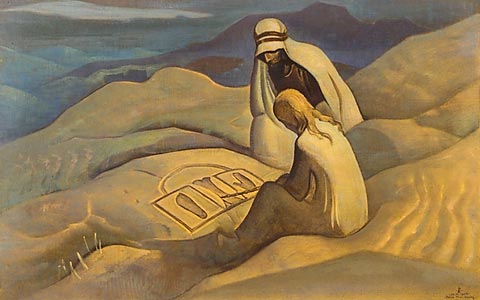
And
there are also many other things which Jesus did, the which,
if they should be written every one, I suppose that even the world itself
could not contain the books that should be written.
—John 21:25
The popular book and movie, The DaVInci Code, raises many issues about Jesus' life and mission. Most notably, it presents Jesus as both God and man, and as a wayshower of the divine Christ potential that lies within each of us.
To understand Jesus and his teachings as they relate to each one's "Sonhood" or Christ potential, it is important to study the larger historical and more universal spiritual context from which these teachings emanated. Jesus' ministry was influenced by Judaism as well as by Buddhism, Hinduism, Taoism, Egyptian mysteries, and Kabbalic and Essene mysticism. For one, Judea was more than illiterate masses of people living in near-desert conditions and conducting simple activities like fishing and carpentry. It was also a cosmopolitan trade center and an ethnic, cultural, philosophical, religious and political melting pot.
East and West Converge
The two main Jewish sects at the time of Jesus were the Essenes and the Pharisees. The Essenes believed in the immortality of the soul as separate from the body, and pursued the mystical union of man with God. The Pharisees, who dominated the Jerusalem temple during Jesus' ministry, also believed in reincarnation. Josephus, a first century Jewish historian, testifies of the popular belief in reincarnation among Jews, writing, "the souls of bad men are punished after death and the souls of good men are removed into other bodies where they will have the power to revive and live again." Phylo of Alexandria, one of the greatest Jewish teachers who also met with Jesus' disciple Peter, preached reincarnation, union with God, and interpreted the Old Testament in a mystical way.
Greco-Roman influence within Judea was heavily influenced by Orphism, a spiritual belief system that taught both reincarnation and that man has a divine spark. And the trade routes with India opened the door to silk, spices and Eastern spirituality. As far as three hundred years before Jesus, India was already sending Buddhist missionaries into Judea, Greece and Egypt, where more than thirty Buddhist edicts have been found engraven in stone.
Furthermore, ancient manuscripts and oral legends reveal that Jesus received direct training in Egypt and in the East. In India and Tibet, Jesus is known as Saint Issa, where many shrines to Saint Issa can be found. Jesus Lived in India by Holger Kirsten, The Lost Years of Jesus by Elizabeth Clare Prophet, and Heart of Asia and Altai HImalaya by Nicholas Roerich irrefutably document that Jesus went to India and Tibet several times in his life. Tibetan manuscripts first discovered by Russian writer Nicolas Notovitch in the19th century disclose that Jesus spent six years between the ages of 14 and 21 travelling to Tibet and to Indian holy cities like Juggernaut, Rajagriha and Benares. (The story is documented in The Lost Years of Jesus.) When Nitovitch found these manuscripts, he went to Rome, where a high-ranking cardinal told him the Vatican already possessed 63 complete or incomplete documents brought back by Christian missionaries concerning Jesus' activities in the East.
According to the these manuscripts, Jesus insisted on teaching scripture to the lower castes so the priests decided to kill him and he fled to the birthplace of Gautama Buddha in the Himalayan foothills. In Nepal, he mastered the Pali language, became an expert on Buddhist sacred writings and performed miracles at the feet of Hindu sages. He also taught karma and reincarnation, as one passage quoting Jesus about skilled singers records,
"Whence is their talent and their power? For in one short life they could not possibly accumulate a quality of voice and the knowledge of harmony and tone. Are these miracles? No, because all things take place as a result of natural laws. Many thousands of years ago these people already molded their harmonies and their qualities. And they come again to learn still more from varied manifestations."
Jesus left the Himalayas at the age of 27 and slowly returned to Palestine, teaching along the way. Back in Judea he sought to convey to many the path of personal Christhood, be it through parables for the multitudes or through the intimate instruction given to the disciples, holy women and close followers of his message.
Unto you is given to know the mysteries of the Kingdom of God
but to others in parables.
—Luke 8:10Many of Jesus' mystical teachings were recorded in apocryphal gospels like The Gospel of Thomas, The Secret Book of John, The Secret Gospel of Mark, The Gospel of Phillip,The Gospel of Mary Madgdalene, and other texts discovered in 1945 near Nag Hammadi Egypt. The Dead Sea Scrolls discovered in 1947 near Qumran, Israel contain over 200 documents, including biblical commentaries, prophecy, and community rules. These gospels, which predate the Biblical gospels, supply further evidence that Jesus spoke of reincarnation, performed secret initiation rites like those of ancient mystery schools and taught precepts also found in Buddhism, Taoism and Tibetan spiritual traditions, and upheld women.
Before I formed you in the womb, I knew you;
before you came to Earth I consecrated you.
—Jer. 1:5
Karma and reincarnation are key concepts on the path of personal Christhood, as they explain our opportunity to perfect the soul lifetime after lifetime. It is true that our current personality only lives once. Then our souls return, clothed with a new body and personality to experience the next level of earth's classroom, balance karma and fulfill divine purpose. When the alchemical marriage takes place between the soul and Christ, we are ready for permanent reunion with God are are freed from the cycle of rebirth.
Perhaps the reason there are not many direct references to reincarnation in the Bible is because the knowledge of reincarnation was self-evident to the people Jesus addressed, including the Essenes, the Pharisees and the Greeks.Still, the concept of karma is very well illustrated in Biblical scriptures like "whatsoever a man soweth, so shall he reap;" "do unto others as you would have them do unto you," "balancing every jot and tittle" and "with the judgment you make you will be judged and the measure you give will be the measure you get."
Four passages in the New Testament directly point to reincarnation. In the first, Jesus asks his disciples, " Whom do men say that I the son of man am?" Their answer illustrates that the understanding of reincarnation was self evident among Jesus' followers. "And they said, some say that thou art John the Baptist, some Elias and others Jeremias, or one of the prophets." (Matt. 116:13-14) The next two passages relate to John the Baptist as Elijah come again. When John is imprisoned, Jesus delivers a public tribute to him saying, "he, if you will believe me, is the Elijah who was to return."(Matt. 11:14) Later, when John is martyred, Jesus explains, "I tell you that Elijah has come and they have treated him as they please (Mark 9:12). The Gospel of Matthew (17:13) adds to this statement, "The disciples understood then that he had been speaking of John the Baptist."
The third passage related in John 9 refers to the man born blind whom Jesus healed and whom the disciples questioned, "Rabbi, who sinned, this man or his parents that he was born blind?" This question presupposes reincarnation, for how could a man sin before birth had his soul not lived before?[The main Biblical scripture used to deny reincarnation is Hebrews 9:27, "men only die once, and after that comes judgment." It is probably correct to assume here that the author is refering to the body, not the soul especially in light of other events, including Jesus' raising of Lazarus and Jairus' daughter from the dead.]
I disclose my mysteries to those who are worthy of my mysteries.
—Jesus in the Gospel of Thomas
Following Jesus' ministry, reincarnation and the path of personal Christhood was taught for several hundred years by Christian gnostics, until their ministry was shut down by church hierarchy for human power and political gain.
In the second century AD, Origen taught on the preexistence of the soul and explained that earth was a place for man to experience free will. His defense of personal spiritual freedom threatened church fathers like Jerome, who held a far more orthodox viewpoint and professed in the physical resurrection of the dead down to the "flesh, blood, bones and genital organs." Origen was eventually arrested, tortured, and imprisoned by Jerome.A century later, Libyan priest Arius' defense of man's Christ potential led to the fourth century Nicean council and Nicean creed, where church fathers voted to set Jesus apart from other men as the "only begotten son of God." Remaining gnostics were martyred or fled, Origen's work was declared anathema and destroyed, and secret gospels and apocryphal texts were buried. Church father St. Augustine spun the doctrine of original sin to shame the soul, to rob man's awareness of innate Christ potential and to substitute a personal punishing God for impersonal divine laws of karma and reincarnation.
Through the centuries, these political moves were forgotten and self-serving human dogma became spiritual foundation. Millions of mystics who sought the earlier mysteries, like the Cathars in France, were persecuted as heretics and their legacy destroyed. (Their history is recorded in Reincarnation: The Missing Link in Christianity by Elizabeth Clare Prophet.) And sadly to this day, in many Catholic and Protestant churches, an orthodox interpretation of Jesus as "only son" and of an arbitrary and despotic God made in man's image yet prevails.
I will tell you the decree of the Lord. He said to me,
"You are my son; today I have begotten you."
—Psalm 2
Those who pursue the path of personal Christhood understand that the only begotten son of God refers to the Christ consciousness, not to Jesus as a flesh and blood idol. Scriptures about other "sons of God" and about becoming a son of God can be found in both the old and new testaments regarding King David, Melchisedec and others, as well as in Jewish texts like the Book of Levi. In Galatians 4:5, Saint Paul teaches that Jesus came as the "firstborn" to "enable us to be adopted as sons." Hebrews 7:28 states "the word of the oath, which was since the law, maketh the Son, who is consecrated forevermore." And Revelation 21:7 declares, "He that overcometh shall inherit all things; and I will be his God, and he shall be my son."
In the New Testament, Jesus commends us to address God as "our Father" and tells us that those who do the will of God are his brothers and sisters. When Jesus said, "I AM the way, the truth and the life: no man cometh to the Father but by me (John 14:6), he was speaking of the Christ consciousness also referred to by Paul when he said, "Let the mind be in you that was also in Christ Jesus" (Phil. 2:5) and "we have the mind of Christ (1Cor. 2:16).
The Christ consciousness is the way, the truth and the life that saves us from our human ignorance and separation from God. Souls become immortal when they fulfill this consciousness and reunite with the presence of the I AM THAT I AM revealed to Moses in the burning bush. This is what Jesus was referring to when he said, "whosoever liveth and believeth in me shall never die (John 11:26) and when he told the parable of the vine and the branches..Verily, verily I say to you, he that believeth in me, the works that I do shall he do also;
and greater works than these shall he do; because I go unto my Father.
—John 14:12Today, with the rediscovery of these ancient teachings and the freedom of religion secured for us by our founding fathers, we have an unparalelled opportunity to right all wrongs, to follow in the footsteps of our elder brother, master, savior and teacher, to become Christ in our own right and to ascend back to God.
.
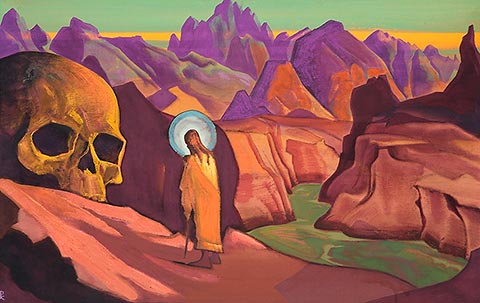
About the painting Issa and the Skull of the Giant by Nicholas Roerich: According to the Teachings of the Ascended Masters released through Mark and Elizabeth Clare Prophet, the soul of Jesus had many incarnations prior to his final embodiment. These include incarnations on Atlantis as well as the lives of Abel, Joshua, Joseph, King David and Elisha, chronicled in the Old Testament. Perhaps Jesus' embodiment as David defeating the giant is what Nicholas Roerich was attuned to in creating this mystical painting of Issa and the Skull of the Giant.
.
.jpeg) |
.